Hello Alanon: A Bold Display Font for Handmade Brands
If you’re designing candle labels, wedding welcome signs, or printable wall art for your Etsy shop, the right display font can make your product feel instantly more intentional — and more sellable. Hello Alanon is one of those rare typefaces that lands with confidence: bold, punchy, and unmistakably modern without sacrificing warmth or charm. It’s not a background player. It’s the headline that stops someone mid-scroll, the name on a boutique tag that feels like it belongs in a curated gift shop, the title on your digital planner cover that whispers “premium” before a single word is read.
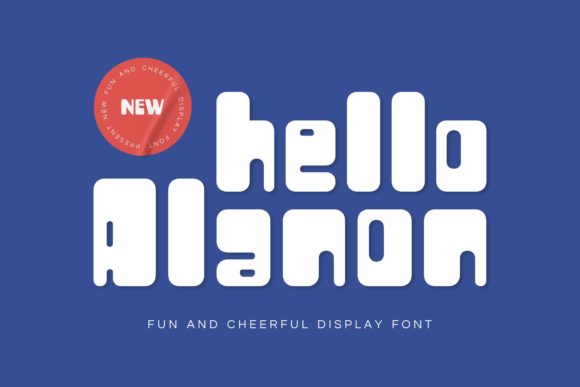
Visually, Hello Alanon balances strong geometric structure with subtle humanist quirks — think generous x-height, open counters, and just enough contrast between thick and thin strokes to give it rhythm without stiffness. It’s friendly enough for a baby shower invitation but sharp enough for a limited-edition coffee bag label. Unlike some display fonts that sacrifice legibility for flair, Hello Alanon holds up beautifully at small sizes (think 8–10pt on printed product tags) and shines even larger — say, laser-cut onto a farmhouse-style wooden sign or vinyl-cut onto a reusable tote.
For crafters using Cricut Design Space or Silhouette Studio, Hello Alanon cuts cleanly thanks to its well-spaced characters and minimal connecting strokes. No tricky loops or fragile serifs to snag on your blade. I’ve used it for 0.75-inch sticker sheets (think mini gift tags or planner icons), and every letter came out crisp — no overlapping, no thin lines collapsing. On matte sticker paper, it reads with quiet authority. On glossy vinyl, it pops with playful energy.
Where does it truly shine? Start with product packaging: soap bars, bath bombs, small-batch hot sauce — anything where you need a name or flavor descriptor to command attention on a crowded shelf or Instagram grid. Try “Wild Mint” in Hello Alanon over a soft sage background, paired with a clean sans serif for ingredients. Or use it for wedding stationery: “Alex & Sam” on a rustic kraft invitation, followed by lighter-weight text for date and venue. It adds personality without overwhelming — especially when printed foil or letterpress.
It’s also my go-to for seasonal digital printables. Last December, I designed a set of holiday mug templates with phrases like “Cozy Crew” and “Hot Cocoa Approved” in Hello Alanon — then layered them over hand-drawn wreaths. Customers loved how festive yet timeless it felt. For spring, I used it on SVG files for floral market bags (“Farm Fresh Today”) and paired it with a light script for the date — perfect for farmers’ market vendors who sell branded totes.
Readability matters — especially when your customers are printing at home or cutting on low-resolution machines. Hello Alanon performs well across formats because its letterforms are distinct and generously spaced. The uppercase “I”, lowercase “l”, and numeral “1” are easily differentiated — a real win when designing product labels where clarity is non-negotiable. Just avoid setting full paragraphs in it; this is a display font, not body text. Use it for headlines, names, titles, short slogans, and decorative accents only.
Pairing Hello Alanon thoughtfully elevates your whole design system. My favorite combo? Hello Alanon + a relaxed handwritten font (like a natural ink script) for contrast and warmth — ideal for greeting cards or boutique price tags. For branding consistency, pair it with a neutral sans serif (think Montserrat Light or Inter Regular) for supporting text. That combination works seamlessly on business cards, social media banners, and packaging side panels. If you're building a brand identity for a handmade ceramics line, Hello Alanon gives the studio name presence, while a simple serif handles “hand-thrown • small batch • Ohio” with grounded elegance.
Before downloading, check what’s included: Hello Alanon typically ships as OTF and TTF files — both fully compatible with cutting software, Canva, Adobe Suite, and free tools like Inkscape. Some versions include stylistic alternates (like a bolder “A” or rounded “O”) and basic ligatures — useful if you’re designing logos or monograms. It supports standard Latin characters and common accented letters (à, é, ñ, ü), so it’s suitable for bilingual shop names or international markets — though always double-check multilingual coverage if you plan to use it for Spanish or French product lines.
One practical note many crafters overlook: commercial licensing. Hello Alanon is a premium font, and its license permits use in physical products you sell (stickers, mugs, apparel), digital downloads (printables, SVG bundles, Canva templates), and client work — as long as you’re not reselling the font file itself. That means you can embed it in a PDF printable, convert it to outlines for an SVG cut file, or use it in a mockup you sell on Creative Market. Just don’t upload the raw .OTF to your Etsy listing as a “font bundle.” Always review the specific license terms — reputable sellers clearly state commercial use rights upfront.
In my own shop, Hello Alanon has become the quiet backbone of several best-selling listings: a minimalist “Coffee Shop Owner” wall art set, a “Welcome Home” wooden sign template, and a collection of editable baby milestone cards. Each time, customers mention how “clean but full of character” the typography feels — proof that good display fonts don’t shout; they resonate. When your handmade product carries Hello Alanon, it doesn’t just look designed. It feels considered, confident, and ready for the shelf — or the cart.